The outbound playbook behind 500+ SDR teams
After nearly 20 years and 500-plus SDR teams, David Kreiger's verdict is that the outbound fundamentals haven't changed — but pipeline quality is what most people get wrong. Spend real time up front on ICP and messaging; set realistic, honest quotas before you sign a client so reps never throw 'crap appointments' over the wall; insist clients have a CRM and a mapped sales process first; and treat outbound as something that needs constant care, not autopilot. The phone, he argues, is still the least-crowded channel in lead generation.
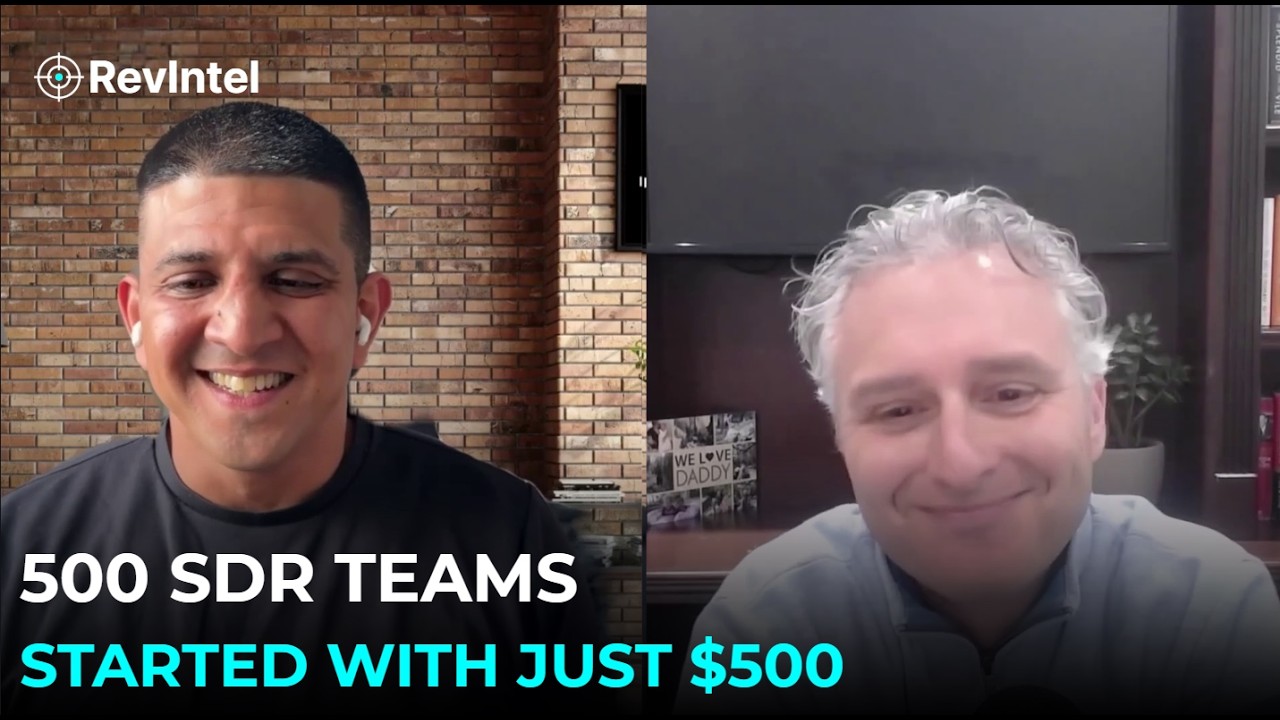
Watch the full episode · 46 min
Key takeaways
Each one a claim that stands on its own.
- Pipeline quality, not activity, is the whole game. Spend real time up front — treating a launch as cookie-cutter (throw it into ChatGPT, skip role-play) is why teams generate noise instead of pipeline.
- Quality control starts before the sale. Most "crap appointments" trace back to unrealistic quotas — if a rep has to beg, borrow and steal to hit a mis-set number, you have engineered the bad behaviour.
- He would rather lose the deal than over-promise. If SalesRoads cannot deliver the appointment volume a client needs for ROI, they say so up front, because a client that churns is expensive.
- He will not onboard a client without a CRM and a mapped sales process — a referral-led startup had to build both before he would launch them.
- Hire later-career SDRs, not kids out of college. With no AE promotion to dangle, people who want the job for what it is are the ones who stay and perform.
- Culture is a real lever, not fluff — always-virtual, a vibrant Slack community, a water-cooler channel, core-value shout-outs. People do not leave companies, they leave managers.
- The phone is the least-crowded channel in lead gen. Email and LinkedIn do not match a good call, and companies still scale, raise rounds and exit through outbound.
- Use AI on back-end sales ops — ICP-vetting lists by reading whole websites, pulling companies with no clean database code, cross-checking prospects, analysing call transcripts. His personal superpower: AI as a brainstorming partner that challenges his thinking.
Chapters
Each heading is the question the guest answers — and a query a buyer types.
- 0:00Who is David Kreiger and why does outbound still work?
- 2:03How did SalesRoads start with $500 and military spouses?
- 5:13When did the business stop feeling like a scrappy startup?
- 9:20Why acquire VSA Prospecting instead of competing?
- 13:56What separates real pipeline from teams that just make activity?
- 19:44How do you build a great SDR team and culture in 2026?
- 23:33How do you guarantee qualified meetings, not just appointments?
- 29:28What do you check first to find the leaks in a sales process?
- 31:55Is cold calling dead, or is the phone still the best channel?
- 35:05Where does AI help in outbound — and where stays human?
- 43:26The one thing to change about your outbound tomorrow
Full transcript
In the page’s HTML — the part search engines and AI answer engines read.
Welcome back. We had David Kreiger on almost three years ago, and a lot has happened since. My guess is he's built over 500 SDR teams, generated more than 100,000 sales opportunities, and started the whole thing with $500 and a mission to employ military spouses. He's the founder of SalesRoads. In 30 seconds — who are you, what do you do, and why should anyone stay on for the next hour?
We've been building SDR teams for the past 20 years — well before the term SDR was even a term. It's been an amazing ride running SalesRoads, thinking through all the things that change in this market. But a lot of the fundamentals stay the same. When I first started, everyone said, 'Why are you doing this? Cold calling is dead.' Here we are 20 years later and the industry is bigger than ever.
You pitched SalesRoads at Wharton's business-plan competition — with $500 in your pocket and an idea to build a remote sales company staffed by military spouses. What made you believe that model could actually work?
A few things. I'd gone back to business school with the goal of not getting a real job and starting my own company, so I was searching for an idea. Before school I'd joined an internet startup in the '99 era as the 16th employee, and the VP of sales asked me to build the whole inside sales team. I had no clue what that even was — I bought Cold Calling for Dummies. But that's how we built all the pipeline. At the same time I was reading about the virtual call-center model — JetBlue was hiring moms working from home. I thought, this could apply to outbound. Sales is a metrics-driven business; you don't need people under your thumb to know they're working. So why not hire people anywhere? Some friends had come back from the military with amazing spouses who struggled to find jobs because they kept moving base to base. That was the genesis — hire those spouses as inside sales reps. We got third place. One and two never even launched, and here we are 20 years later.
From Home-Base USA to a 3X Inc. 5000 company and 500-plus SDR teams. Walk me through the moment the business stopped being a scrappy startup and started feeling like a real company.
We got traction very early. A few months in we pivoted off the military-spouse-only model — we had all these great salespeople who wanted to work from home for a reputable company, and we were turning them away. For the first few years we were still a scrappy startup, fingers in everything. Honestly, what changed it was hiring a coach to give me perspective — refine the org chart with clear accountabilities for every person, and build dashboards at every level so everyone knows what winning looks like. I'm a solopreneur; I didn't have a co-founder. Having that outside person say, 'David, you're all over the place, let's organize you' — that was amazing for me and the business.
The most important first hire is different for everyone — you have to know your strengths and weaknesses, and that person has to be the yin to your yang. They should think a little differently than you, so you have some perspective. Especially without a co-founder, you need to be challenged. I understand hiring an admin at a certain stage when you're just trying to get leverage. But for me it's been the person with a different skill set who challenges me and complements me along the way.
There's been a lot of M&A in the space, and you just did it yourself — you acquired VSA Prospecting in January 2025. You and Valerie are both Wharton grads who built lead-gen companies over decades. What made you decide to buy rather than compete?
Valerie and I met at a Wharton networking event when I was still a student, and we realized we were building something similar. We kept in touch for 20 years, helping each other — as agency owners you run into the same problems, so why invent everything yourself? We'd compete for business vigorously, but we also helped each other. She got to a point where she wanted to step down and spend more time with her grandkids, so she approached me. Combining two companies is always harder than you think. The most important thing is cultural fit, because we're a people business — force two sets of people together and it's like a heart transplant with the wrong blood type; the body rejects it. I've looked at these deals from both sides for years and consistently said no. This one made sense.
You've built more SDR teams than almost anyone alive. Across all of them, what's the pattern that separates the teams that build real pipeline from the ones that just create a lot of activity?
First, spend time up front. Some agencies have a kickoff and launch tomorrow — cookie-cutter, throw it into ChatGPT or Claude, spit out sequences, maybe don't even role-play. You've got to think through what's special about this organization and each buyer persona so you cut through the clutter. It's almost a mini consulting project. Second, don't go too broad — think hard about your ICP. A lot of companies come to us without having done that work, and the beauty of outbound is you can be incredibly targeted. Third, it's not set-and-forget. Even with experienced SDRs you role-play and manage the nuances, because they get sloppy, or set one appointment with the wrong messaging and suddenly think that's the message. And last, where it all started for me: you need great people who engage empathetically, ask good questions, and don't come off as pushy on a cold call. That's really hard.
What makes a great employee today? Is it incentives, getting to know them, collective activities? What's working to drive true motivation and camaraderie in 2026?
It starts with selection. We don't hire kids straight out of college — that can work for a year or two, but most want to get promoted into an AE seat, and we don't have that role. So we recruit people later in their careers; they know what they're getting into and they like the job for what it is. You need a realistic commission plan — throw out numbers people can't hit and it's demotivational. But what we've really invested in is culture and community. We've always been virtual — pick which one you are and build a culture around it. We have a vibrant Slack community, a water-cooler channel, game days, core-value shout-outs with little prizes — 'own the outcome,' 'never stop learning.' People stick around because they love the people they work with and they don't hate their managers. People don't leave companies, they leave managers.
Say I'm a client and I ask you to build pipeline. How do you give me confidence that what your team generates is genuinely qualified — not just meetings on a calendar that show up and go nowhere?
It starts before we even make the sale, because a lot of that behavior comes from unrealistic expectations. If an SDR has to beg, borrow and steal to hit a quota that's mis-set, you're already encouraging bad behavior. So we spend a lot of the sales process figuring out what's doable on our end and what's needed on theirs. Other agencies promise 10 appointments a week — how do you know you can do 10 when you don't even know what you're selling or to whom? We have historical data and a calculator to make sure it's aligned. If we can't deliver the number that gives them an ROI, we'd rather say so up front — otherwise they churn, and that's expensive for us. And we just don't accept crap appointments. It's worse than no appointment, because you're wasting an AE's — or a founder's — time. We record calls for QA to catch it, and if an SDR sets unqualified appointments, those get written up.
Say I'm a CMO or VP of Sales, new in the role, looking at my existing sales process for the first time. What's the first thing you check that tells you where the leaks are?
We check whether they have a buttoned-up sales process, because if they don't, they'll waste money — go-to-market is expensive. We just signed a cool early-stage startup that had only ever sold to referrals. Referrals are a different, easier sale — they had no process and no CRM. I told them we cannot work with you until you have a CRM and a mapped-out sales process: a discovery, a demo, a few stages, tracked in the CRM. They built it out, we launched last week, and it's already been kicking. If you don't fix that before you start, it's going to be a mess.
The phone is the least-crowded channel in lead generation right now. There's so much noise — influencers, coaches, everybody — that it's hard to know what's actually good. When a real person calls you, is authentic, has personality and business acumen, it changes everything. An email is nowhere near a good phone call; a LinkedIn message isn't either. Most people think cold calling is dead — it's far from it. I see companies scale, raise rounds, exit and go public through the outbound channel day in and day out. You do need enough margin in what you're selling and the numbers have to work, but when they do it's the most predictable way to generate revenue.
Where AI has been phenomenal is the back-end sales-ops motions — lead targeting, lead scrubbing, reporting analysis. On every company list we pull with the usual selects, then spin up an AI agent to verify they fit the ICP by reading the whole website, instead of an SDR eyeballing it. And where there's no select — try pulling MSPs out of ZoomInfo, there's no clean code for it — an AI agent gets you exactly the type of company. On the prospect side it cross-checks LinkedIn and social footprint: is this person still there, did they say anything relevant. On reporting you can ask for every objection a title gave and the responses. Outbound cold AI calls are technically still illegal, so we don't go near that for clients — some people play in the gray area, we don't.
The biggest thing for me — and it can go very wrong if you use it the wrong way; I think as a society we risk becoming stupider — is leveraging AI as my brainstorming partner. I like to talk things out and think them through. I prompt it to challenge me, to find the holes in my argument. That's been hugely helpful as I think through ideas I'm rolling out. Outside my company I see people just outsource their thinking to AI — that's the risk. But as a thinking partner, it's been one of the most helpful things for me.
Even the largest companies think outbound is autopilot — that it should just work. It's the one thing that needs constant focus. It changes faster than almost anything and has the highest turnover of any department. It is not set-it-and-forget-it. You might get lucky, but more often than not, when people say outbound doesn't work, it's because they haven't focused or spent enough time on it. Give it the care and attention, and it pays back in spades.
Thank you for watching the whole way through. If you liked it, click subscribe — it takes two seconds and helps me reach amazing guests. And if you want to find out what we do, go to gorevintel.com, where we help founder-CEOs make decisions backed by intelligence. That's it for me — I'll see you on the next episode.
About the guest
David Kreiger
David Kreiger is the founder and president of SalesRoads, a B2B appointment-setting, lead-generation and SDR-outsourcing agency he started with $500 and a mission to employ military spouses — an idea that placed at the Wharton business-plan competition. Over nearly 20 years he has built more than 500 SDR teams, generated over 100,000 sales opportunities, and taken SalesRoads onto the Inc. 5000 three times. He holds a Wharton MBA and hosts the "Sell Like A Leader" podcast.
Related reading on gorevintel.com
See what happens after the meeting is handed over
RevIntel gives agencies a shared record of every booked meeting — proof of what happened after the handover, without touching the client’s CRM.
See how RevIntel works