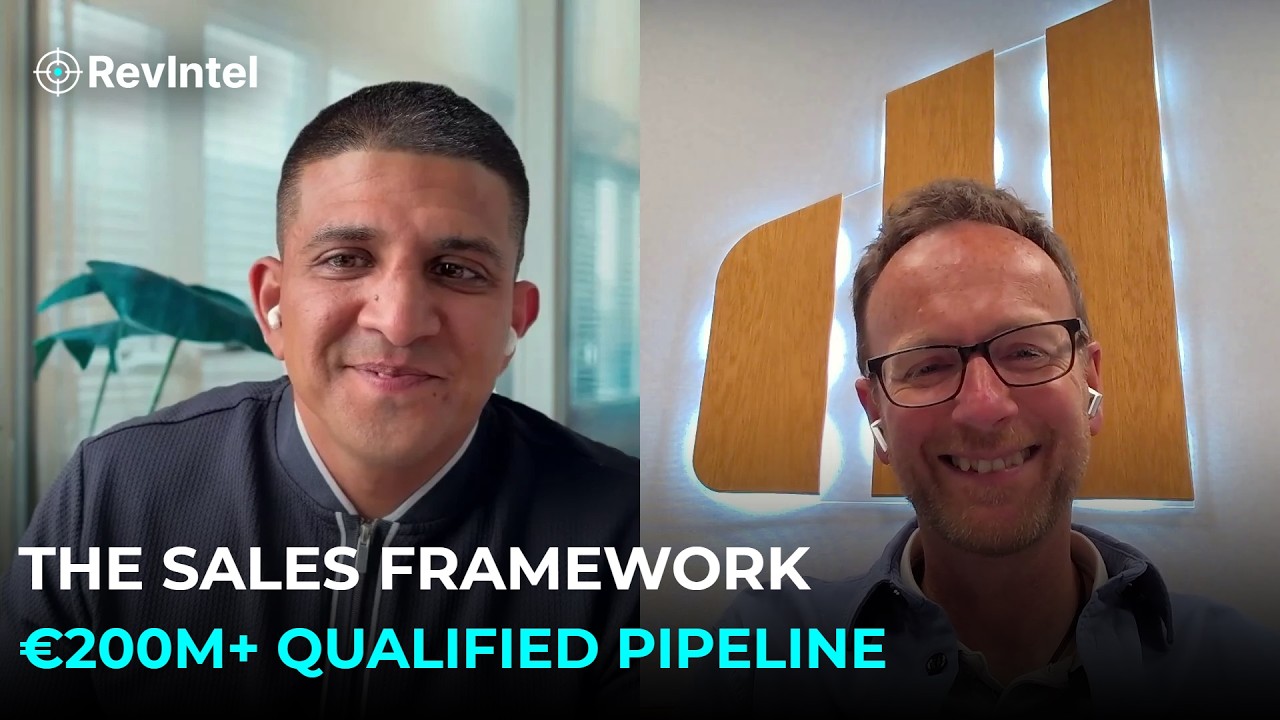
The sales system behind €200M+ in qualified pipeline
Durham Lane runs outsourced SDR teams that have built €200M+ in qualified pipeline, so Richard Lane sees inside more pipelines than almost anyone. His test for what's real: judge four things — inputs (ICP and data), outputs (the calls and emails you make), outcomes (the qualified meetings created), and insight into why every yes and no happened. And by mid-quarter, one question exposes the ghosts: what's the compelling event driving the buyer to change?
Watch the full episode · 34 min
Key takeaways
Each one a claim that stands on its own.
- Judge pipeline on four things — inputs (ICP + data), outputs (calls + messaging), outcomes (qualified meetings), and insight into why every yes and no happened. Most agencies skip the insight.
- "Be interested to be interesting" — you don’t need to be an expert in the product, just in why someone should care.
- No compelling event, no deal: people walk away from a negative faster than they walk toward a positive.
- Move from time-and-materials to outcomes — and don’t judge a six-month contract when the sales cycle is nine to eighteen months. Sales velocity is the key.
- Deals die single-threaded: a keen sales director is not the buying committee. Multi-thread early.
- Watch the attribution trap — reps close an agency’s opportunity as "lost", then reopen it as self-generated, stripping the agency’s tag. That’s exactly where a shared record matters.
- AI won’t pick up the phone for outbound. Richard built an AI SDR pilot ("Geordie") that fell on its face. Inbound AI is interesting; outbound still needs humanness.
Chapters
Each heading is the question the guest answers — and a query a buyer types.
- 00:40Who is Richard Lane, and what does Durham Lane actually do?
- 02:17The "happy trip-up": falling into sales and being proud of it
- 06:37The hardest phases of scaling from 2 to 220 people
- 09:44How do you sell for others while selling for yourself?
- 13:15What a client’s CRM never tells you — the four things to check
- 16:53Why do deals die "only in the seller’s head"?
- 20:03"Be interested to be interesting" — training 120 SDRs not to pitch
- 22:05Why won’t AI pick up the phone? (the "Geordie" pilot)
- 28:15Magic 35 and the compelling event: spotting real deals by mid-quarter
- 29:48The one thing to do this week to test a pipeline you don’t trust
Full transcript
In the page’s HTML — the part search engines and AI answer engines read.
Richard Lane, co-founder and chief commercial officer of Durham Lane. We're an international SDR agency — we build white-label teams for mainly mid-market and enterprise customers across data, AI and technology. Most importantly, people who deliver amazing revenue results for our customers. I've spent my whole life in sales — built sales processes for many organisations, coached hundreds of salespeople, led many teams to success.
Richard built Durham Lane with his co-founder from two people to an agency of 220, and you've generated over €200 million in qualified pipeline, running outsourced SDR operations for companies like Sage, HP and Deloitte. So you see inside more sales pipeline than almost anybody in the UK. Today we're getting into how you spot the difference between pipeline that converts and pipeline that's just noise.
From the age of 15 I was clear I was going to be a professional musician, and at 23 I realised that wasn't going to happen. I snuck into Oxford University Career Service, got put through an assessment, and they said 'we think you'd be great at market research.' No one recommends sales as a profession, and we see it as a profession to be proud of. I call it the happy trip-up club — I fell into it, found I was really good at it. I listen really well, put myself in the other person's shoes, and I'm diligent and curious.
You and Lee started this in 2011 with a mission to make people proud to be in sales. Fifteen years in, you're running outsourced sales for some of the biggest companies in the world. What was the hardest phase of that growth?
Every phase has been difficult. Two to 25 people, you're a little tribe, in it together, sorting everything out down the pub. 25 to 50, you need more process and people willing to manage others. 50 to 100, you become a proper company — you have to become more of a machine. I actually really like that; I've always been comfortable in corporate land. But it's definitely not for everyone.
When you're selling your own business you feel this pressure still today — every discovery call, every negotiation, every client review, we have to be the best version of ourselves, because that's what people expect. You've got to sell your own business in order to win the business to then sell their business. Part of our job now is making sure it's not all about me or Lee — there's no one in the business I'd be afraid to put in front of a customer.
When your team opens up a client's CRM for the first time, what's the first thing you look at that tells you where the real leaks are?
We've built a diagnostic. We've shifted from time-and-materials to outcomes-based, so data is critical, and sales velocity is the key — you can't scream at your agency on a six-month contract when you told us your sales cycle is nine to eighteen months. There are four things I always look at: inputs, outputs, outcomes, and insight. Inputs is the ICP, the data, the enrichment. Outputs are what's in our gift — the calls, the emails, the messaging. Outcomes are the qualified, meaningful meetings we create. And insight — which most people forget — is understanding why, whether someone says yes or no. Every line of data has value and insight behind it.
I talk about partnership with a capital P. People outsource because they've got a problem — but it's no good outsourcing to us if you don't want to engage. We'd rather not have the work, because it won't be successful, and that's no good for anyone. We're looking for long-term relationships.
Many deals are lost, and it's only in the seller's head. Can you give me a real example — a deal where everyone thought it was moving but the customer was never actually in?
It comes back to being single-threaded. If you're working with a sales director who thinks it's a great idea — great, but who else is involved? The buying community has got bigger and bigger. What we're getting much better at is, once contracted, exploring the organisation — because at some point a CFO presses a button and asks 'what return has been created?' And if they've not tracked it in CRM, or worse, they've been closing it lost and reopening a new opportunity marked self-generated with no Durham Lane tag on it — that's a big challenge for us. Maybe that's where RevIntel comes in. You have to get there early and make sure the systems are set up right.
Your methodology is built on asking questions, not pitching — 'be interested to be interesting.' How do you train 120 SDRs to do that when their first instinct is to talk about the product?
'Be interested to be interesting' is mantra number three in Selling at a Higher Level. I tell customers we don't need to be experts in your business — we need to be experts in why somebody should be interested. That stops you being a product monkey. Normally you get two weeks of product training, no sales training, and go out able only to talk about your product, which no one cares about. People care about the stories, the why, and who else is using it and why. So we reverse-engineer it all back, and Magic 35 — our qualification framework — tells reps where to go next.
As you'd expect, I ran a pilot last year — I built an AI SDR, we called her Geordie. I made loads of mistakes. I got interested in giving her information and was pleased she answered my questions, but we didn't think about the campaign — which is ridiculous for Durham Lane — so it totally fell on its face. I'm a massive fan of AI, but for outbound there's something about the humanness that's still really important. For inbound it could be interesting. You cannot do what we do without speaking to people — we're very much phone-first.
One of the seven criteria in Magic 35 is the compelling event. If we don't know the outside force driving someone to make a decision — and sometimes the customer doesn't either — the deal doesn't happen. People walk away from a negative situation more quickly than they walk towards a positive one. Our biggest risk of a deal never happening is just not enough of a compelling event.
If a sales leader is watching and their pipeline looks healthy on paper but they don't trust it — what's the one thing they should do this week to figure out what's real?
Pick up the phone to the prospect and ask, in a curious way, what's driving them to make this happen. Then be silent. When they say it's a board initiative, ask when the board meets. If they say the short list goes to the next board in June, but your rep forecast it for May — that ain't happening. The compelling event and the timing tell you whether the forecast is real.
Keep selling — selling is amazing, a profession to be proud of. If we can help with your revenue generation, it's DurhamLane.com. And I love chatting about sales on LinkedIn.
About the guest
Richard Lane
Richard Lane is Co-Founder and Chief Commercial Officer of Durham Lane, an international SDR agency that grew from two people to 220 and has built €200M+ in qualified pipeline — running outsourced SDR teams for the likes of Sage, HP and Deloitte.
Related reading on gorevintel.com
See what happens after the meeting is handed over
RevIntel gives agencies a shared record of every booked meeting — proof of what happened after the handover, without touching the client’s CRM.
See how RevIntel works