The father of Predictable Revenue on why frameworks are dying
Aaron Ross won't quite say frameworks are dead — he built one. His point is sharper: any playbook you can pull from a few sales books gets instantly commoditised and copycatted, and AI now does that left-brain work for everyone. What stays durable is right-brain work — intuition, creativity and relationships — plus nailing a niche and mastering the fundamentals. Frameworks still help; they just no longer differentiate you.
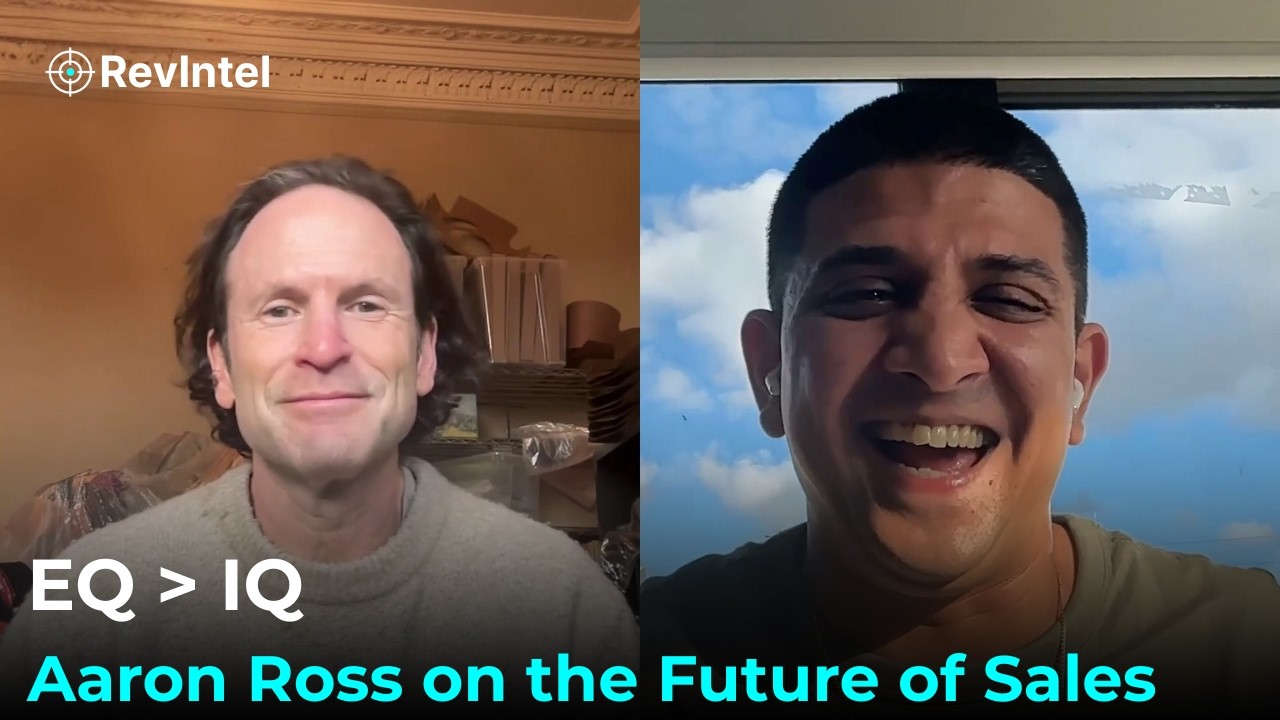
Watch the full episode · 63 min
Key takeaways
Each one a claim that stands on its own.
- Aaron resists the "frameworks are dead" framing — he says he didn't automate sales, he assembly-lined it, "like the Toyota way." The real threat is instant commoditisation and copycatting: do something interesting online and everyone copies it right away.
- Left-brain work — analyse this, draft that document — is exactly where AI takes over and amplifies. The durable differentiator is right-brain work: intuition, creativity and relationships, which Western culture barely cultivates.
- EQ isn't his "hardest lesson" — he pushes back on that. Both IQ and EQ have always mattered; EQ is just more relevant now. Most decisions are made from emotion and justified afterwards, because humans aren't rational.
- Seeds are the most undervalued channel. Of spears (cold outbound), nets (broad marketing) and seeds (word-of-mouth referrals), almost nobody builds a system to ask happy customers for referrals to specific people — even though the close rates are far higher.
- Most broken outbound comes down to three things: not nailing a niche (about 80% of the problem), unrealistic expectations, or simply the wrong person in the job.
- Expect four to six months, not 30 days. B2B SaaS outbound needs months of testing and iteration; Aaron is openly sceptical of "my agentic system got 100 appointments in 30 days" stories and says he doesn't know anyone actually running one.
- The iceberg model: execution sits above the waterline; below it is team friction, and at the bottom is mental noise — your own FOMO, fear, uncertainty and doubt.
- Careers move like Frogger — you jump to the next log and look for the next one, rather than reverse-engineering everything from rigid goals. Relationships outlast companies, and a hobby is the simplest place to start building the relationship muscle.
Chapters
Each heading is the question the guest answers — and a query a buyer types.
- 0:40Who is Aaron Ross — and did he really automate sales?
- 3:06Why was embracing "author" harder than building a consulting firm?
- 4:29The Frogger theory of a career: why backward-planning from goals is exhausting
- 6:33How do you build durable success when everything gets copycatted instantly?
- 8:17Do you ever feel trapped by your own framework?
- 15:50Why will right-brain work — intuition, creativity, relationships — beat AI?
- 25:10Is EQ really more valuable than IQ?
- 33:05If AI automates the SDR, why does EQ win?
- 39:44Outbound is broken: what is the first thing to fix?
- 46:43Spears, seeds and nets — where is the biggest arbitrage?
- 56:09One thing founders can do tomorrow to build the relationship muscle
Full transcript
In the page’s HTML — the part search engines and AI answer engines read.
Welcome back — first podcast of the year, and today I've got Aaron Ross. He wrote the bible on modern sales: Predictable Revenue didn't just sell books, it built the SDR model that powers Silicon Valley today. But ask him what matters now and he'll tell you EQ is far more valuable than IQ, and relationships are more powerful than GTM frameworks. The man who automated sales is telling us to go back to being human. Aaron, who are you and what do you do?
You're jumping in with the clickbait already. I wouldn't say I automated sales — what I did was assembly-line it, like the Toyota way. But yeah, there's the Predictable Revenue book, and then the sequel, From Impossible to Inevitable, which I did with Jason Lemkin of SaaStr. My background was an engineer; I ended up in sales through no particular plan. I'd started a company, raised money, it failed, and I thought — okay, I've got to learn sales.
So I joined Salesforce.com at the lowest level, the most junior employee. Within a few months I was answering the 800 line and inbound leads, and then I created this outbound prospecting system that helped them almost double their enterprise growth. Then I wrote Predictable Revenue about it: how do you create a systematic approach to generating pipeline first, and then sales. From Impossible to Inevitable was more of a leadership book about how to create predictable growth.
You've listed your biggest career win as embracing being an author. A lot of people would say it was building a multi-million-dollar consulting firm, or changing the way the whole sales industry operates. Why was accepting that identity so hard, and what changed when you finally did?
Life is strange. Think about the game Frogger — you're a frog on the bank trying to get to the other side, and all you can do is jump to the next log. Once you're on it, you just look for the next opportunity; you can't predict five moves ahead. That's been my career: I don't really know, I just do the next thing in front of me. Coding, engineering, investment banking, software. I never had this idea of, I want to be this thing someday and work towards it.
We get so focused on goals because we're taught that if you don't have goals, you're failing — your plan for the day, the month, the quarter, the year. It's exhausting. If your company is scaling and everything's working, fine, model it out — but that's the exception. What we don't do enough of is let the interests bubbling away in the background creep up on us. Sitting with those, sometimes over years, can actually unlock huge opportunities.
You basically have instant commoditisation now — instant copycatting. If you do something interesting online, everyone copies it right away. So for the future of sales and growth, whether you're an individual or a company, letting those tangential, almost weird interests creep up on you and sitting with them can unlock big future opportunities. The author thing sat with me since I was a kid reading science fiction; at Salesforce I started blogging, and later it became a book.
For years you were the Predictable Revenue guy. Do you ever feel trapped by your own framework? How did you give yourself permission to evolve beyond the system you created — without saying, this is my thing and I've got to change it now?
It's the golden handcuffs — you get really successful at something and then you're sick of it. I'd been doing the Predictable Revenue consulting and training for about ten years, and I had a business partner I just couldn't work with; I needed a business divorce. I have a big family — ten children — so I had to make a lot of money. And I'll put a point on it: I didn't make lots of money and then have lots of kids; I had lots of kids, so I had to make more money. The buyout ran over a few years, and it's been five years — I still haven't fully replaced that income, but I've built work I actually love doing.
We're looking at how go-to-market changes in a post-AI world. Honestly, if you read three or four sales books, you generally don't need to read more — so what differentiates people so they don't get commoditised? To me, left-brain work — analyse this, create that document — is where AI is most able to take over and amplify. The harder part, where people really differentiate, is the right-brain stuff: intuition, creativity and relationships. Western society doesn't cultivate those very well.
People generally don't trust their intuition — they want data. Show me the data, prove the ROI, then I'll say yes. But anyone who's ever had enormous success knows that's not how it works. The big leaps usually come from: I'm not really sure here, but this is important, so I'm just going to go for it. Relationships are a simple place to start — invest in them systematically, team to team, sales to customer, CEO to market — and that creates durable success no matter what happens with AI.
You've said your hardest lesson is that EQ is far more valuable than IQ — which is a big statement from a data-driven sales-process guy. What specific failure or moment taught you that?
By the way, I wouldn't say the hardest lesson was EQ — it's that EQ is just more relevant now. They've always both been important and always will be; in the past it was more about IQ, because of tech and STEM. But raising ten kids — some biological, some from a prior marriage, some adopted — and staying married coming on 15 years, moving from California to the UK: it's amazing how little of that is IQ. Most decisions are made from emotion and justified afterwards. Humans aren't rational.
Think of an iceberg. The results you want — growth, the framework, the tactic, the comp plan — that's the tip above the waterline. If you're not getting them, the second layer is team friction, and there's more of that than ever: time zones, cultural gaps, values, politics. The bottom layer is mental noise — your own FOMO, fear, uncertainty and doubt. If you at least know where you get stuck, you don't get trapped in the rut.
If a founder's outbound motion is broken — emails aren't converting, SDRs are burning out — where's the first place they should go? What's the first step to fixing it with their team?
Usually it's a lack of clarity on their ideal customer profile — they haven't nailed the niche. That's the first chapter of From Impossible to Inevitable, and you can get it free at fromimpossible.com. Nailing the niche is about 80% of the problem. The second is unrealistic expectations: with B2B SaaS outbound it can take four to six months of testing and iteration to get something working, not 30 days. You'll see these biased stories — in 30 days my agentic system got me 100 appointments. I don't know anyone who's actually got one of those working; Jason Lemkin has the best information on using agents in sales at SaaStr. The third reason is you've just got the wrong person in the job.
Spears, seeds and nets. Spears are cold outbound to people you don't know, nets are broad content and marketing, and seeds are word-of-mouth relationships — you plant them and don't know when they'll grow. Seeds are always the most undervalued. Almost nobody has a system to ask happy customers for referrals to specific people. Cold email is more satisfying on a dopamine level — I can send 100 a day — but the close rates on referrals are so much higher for the energy invested.
Honestly? If you don't have a hobby, think about what hobby you'd like to do. If you do have one, realise there are lots of people in your sphere who like the same thing. The big mistake — and it's going to matter more and more — is keeping your work life in a box, no casualness, no hobbies, no talk about anything else. You only limit how you can connect with people. Sales and marketing is just a psychological exercise between two people who don't know each other yet. So don't overthink it — a hobby is a simple place to start.
The next book is coming out, called Predictable Income — it'll be on Amazon, more for individuals. I don't have a great site, so email is probably the best way to reach me for now. I'm on LinkedIn, but I've maxed out my connections, so that's tricky. It's aross383.com.
Thank you for watching the whole way through. If you liked what you saw, click subscribe — it takes two seconds and it helps me reach amazing guests. And if you ever want to find out what we do as a business, go to gorevintel.com, where we help founder-CEOs make decisions backed by intelligence. That's it for me — I'll see you on the next episode.
About the guest
Aaron Ross
Aaron Ross wrote Predictable Revenue — the book that defined the modern SDR and outbound "Cold Calling 2.0" model — after building the outbound sales-development engine at Salesforce, where it helped almost double enterprise growth. He later co-wrote From Impossible to Inevitable with Jason Lemkin of SaaStr, and is Co-CEO of Predictable Revenue. He is now writing several new books, including Predictable Income.
Related reading on gorevintel.com
See what happens after the meeting is handed over
RevIntel gives agencies a shared record of every booked meeting — proof of what happened after the handover, without touching the client’s CRM.
See how RevIntel works